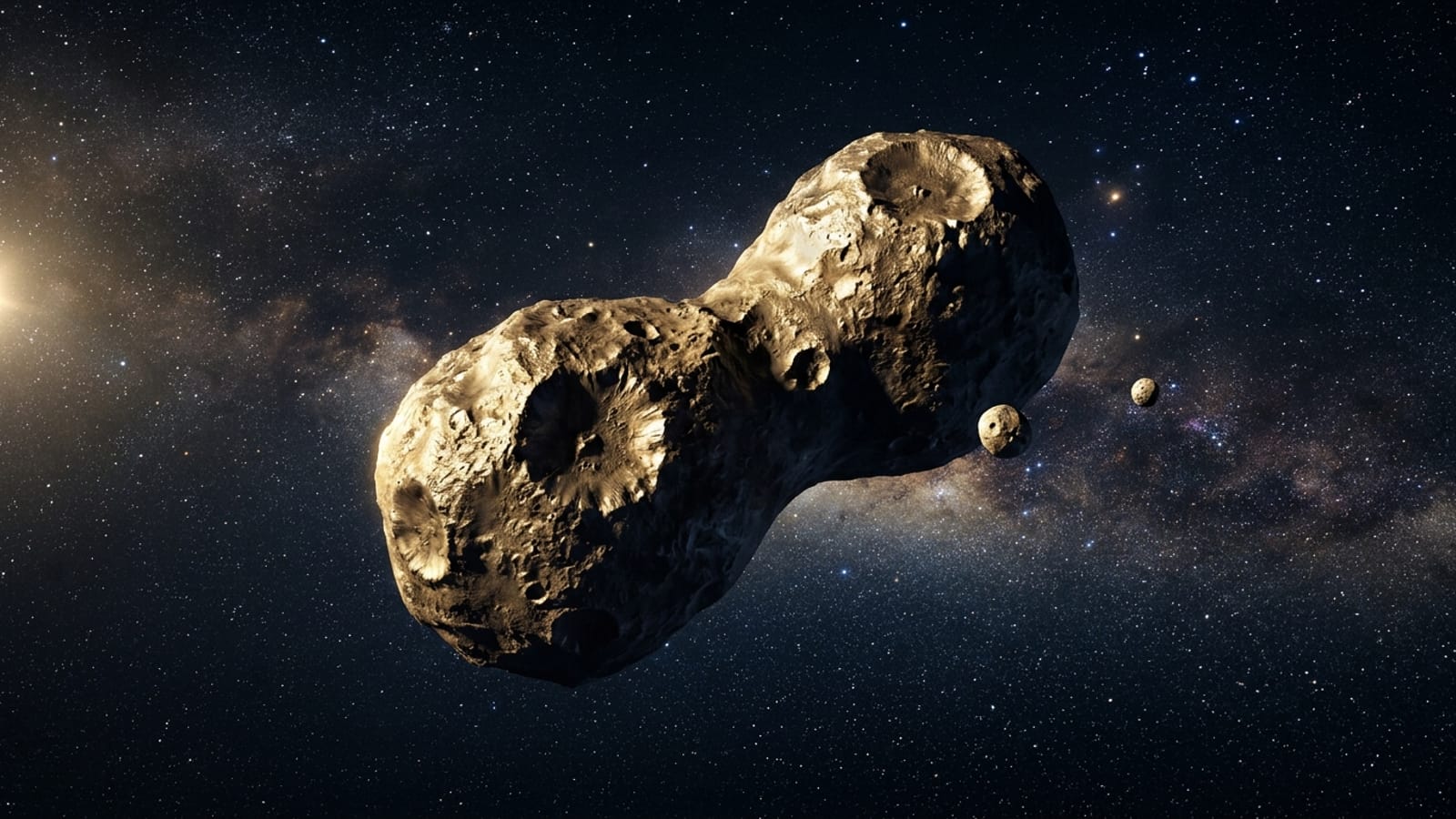
216Kleopatra
The Dog-Bone Asteroid of the Main Belt
216 Kleopatra is a 1-of-1 ERC20 token on Uniswap — raising awareness for one of the most unique asteroids in our solar system.
← actual bone morphology · 217 km long →
History of Observation
From its discovery in 1880 to cutting-edge VLT observations in 2021 — the scientific journey to understand Kleopatra's remarkable shape.
- 1880Johann Palisa
216 Kleopatra discovered at Pola Observatory in Austria. Named after the Egyptian queen Cleopatra VII, it was catalogued as asteroid number 216.
- 1895Various Astronomers
Early light-curve observations begin to hint at an unusual, elongated rotation signature inconsistent with a simple spherical body.
- 1986Steven Ostro & Team
Radar observations using Arecibo Observatory reveal a highly irregular, elongated shape — the first indication of Kleopatra's extraordinary bone-like morphology.
- 2000S. J. Ostro et al.
Arecibo and Goldstone radar imaging produce the first detailed 3D model of Kleopatra, confirming the iconic dog-bone shape with two large lobes connected by a narrow neck (~217 km end-to-end).
- 2008Franck Marchis & Team
Two small moons, Alexhelios and Cleoselene, are discovered orbiting Kleopatra using adaptive optics on the Keck II telescope. The discovery allows the first precise mass measurement of the asteroid.
- 2011Descamps et al.
Revised mass and density estimates from moon orbital data indicate Kleopatra has a bulk density of ~3.6 g/cm³, suggesting a rubble-pile interior with significant porosity despite its metallic M-type composition.
- 2021Vernazza et al. / ESO VLT
The ESO Very Large Telescope (VLT) SPHERE instrument captures the highest-resolution images of Kleopatra to date, precisely mapping the bone shape and refining size and volume estimates. New density of ~4.27 g/cm³ confirmed.
- 2021Brož et al. / ESO VLT
Simultaneous VLT study refines the orbital parameters of both moons and confirms their positions are dynamically stable within Kleopatra's Roche limit — a remarkable finding for a contact-binary-like body.
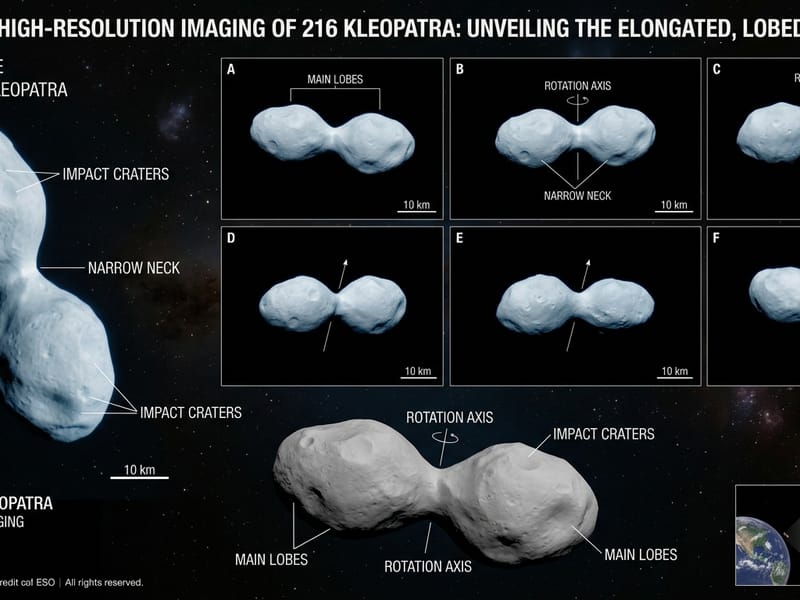
ESO VLT/SPHERE observations revealing Kleopatra's lobed shape — Marchis et al. (2021)
Key Facts
Scientific measurements and orbital parameters characterizing one of the asteroid belt's most intriguing objects.
Visual Gallery
Radar imaging, telescope photography, and spacecraft observations — every captured angle of 216 Kleopatra across decades of exploration.
BONE-NOMICS
The 216 Kleopatra asteroid, just like its $BONE token, is truly one of a kind.
The original M-type asteroid token — 216 Kleopatra's $BONE brings the solar system's most iconic dog-bone shaped asteroid to the blockchain. Zero tax. Renounced. LP burnt. Pure community.